03 — The Exodus
Those who can leave, leave.
Every year, when nights become unlivable and the grid can't cope, Nouakchott empties. This is not a figure of speech.
Four ways out
Nouakchott's thermal exodus isn't a single event. It's a phenomenon with four speeds, four levels of means, four different experiences of the same heat.
Those who go abroad
The wealthiest families leave the country entirely during the worst months. They go to Europe, the Gulf, Morocco, Tunisia — anywhere the summer is bearable or the AC is reliable. This is extremely common. Some leave in June and don't come back until November. Others shuttle back and forth, spending the worst weeks abroad and the rest in Nouakchott. Leaving for the summer isn't a rare luxury — it's a way of life for a significant portion of the city's upper and middle class.
Those who go to the interior
Just below them, families who can't afford to leave the country go back to their home villages — in Hodh, Assaba, Tagant, Guidimakha. The villages are less dense, more ventilated, and the key thing: concrete doesn't trap heat there the way it does in Nouakchott. The city was built on sand but it's become a mass of concrete and sheet metal that absorbs daytime heat and releases it all night. The villages don't have that problem. Some families combine both — a few weeks abroad during the peak, the rest of the time in the village.
Those who commute every night
Then there are those who can't leave the country or the city but can no longer stand the nights. They make the round trip every day. After work, they drive out of Nouakchott — toward the Akjoujt road to the north, the Nouadhibou road to the northwest, the Route de l'Espoir to the east.
They sleep in legzer (singular: gazra) — minimal roadside structures. Sometimes a tent-shaped cement building, sometimes just a few poles, a sheet metal roof, and covers on the sides. These aren't permanent homes. They're sleeping places — structures built for one purpose: staying cool at night.
Nouakchott's concrete radiates the heat it stored during the day. The legzer are open to the wind, isolated from the urban fabric, sitting on sand that cools fast. In the morning, everyone drives back to work. It's a nightly evacuation — a daily commute imposed by heat.
Those who stay
And then there are those who stay. Some have no choice — their work holds them and no one can replace them. Others simply have nowhere to go — no home village, no family in the interior, not the means to get even as far as the legzer on the outskirts. They take the nights as they come, in dense neighborhoods where heat is trapped and AC either doesn't exist or doesn't work because the power is out.
The thing to understand is that the vast majority of Nouakchott's residents leave the city one way or another during the hottest months. Abroad, to the interior, to the legzer — the destinations vary by means, but the movement is the same. The city empties. This isn't marginal. It's how Nouakchott works in summer.
The exodus window
The temperature data lets us pinpoint exactly when nighttime thermal pressure peaks. The five longest consecutive hot-night streaks since 2019 all start between late August and early October:
Not a coincidence. A structural pattern that repeats every year without exception. The August–October window is when the city hits its thermal ceiling. It's when the legzer fill up, the bush taxis to the interior are packed, and the residential neighborhoods empty out.
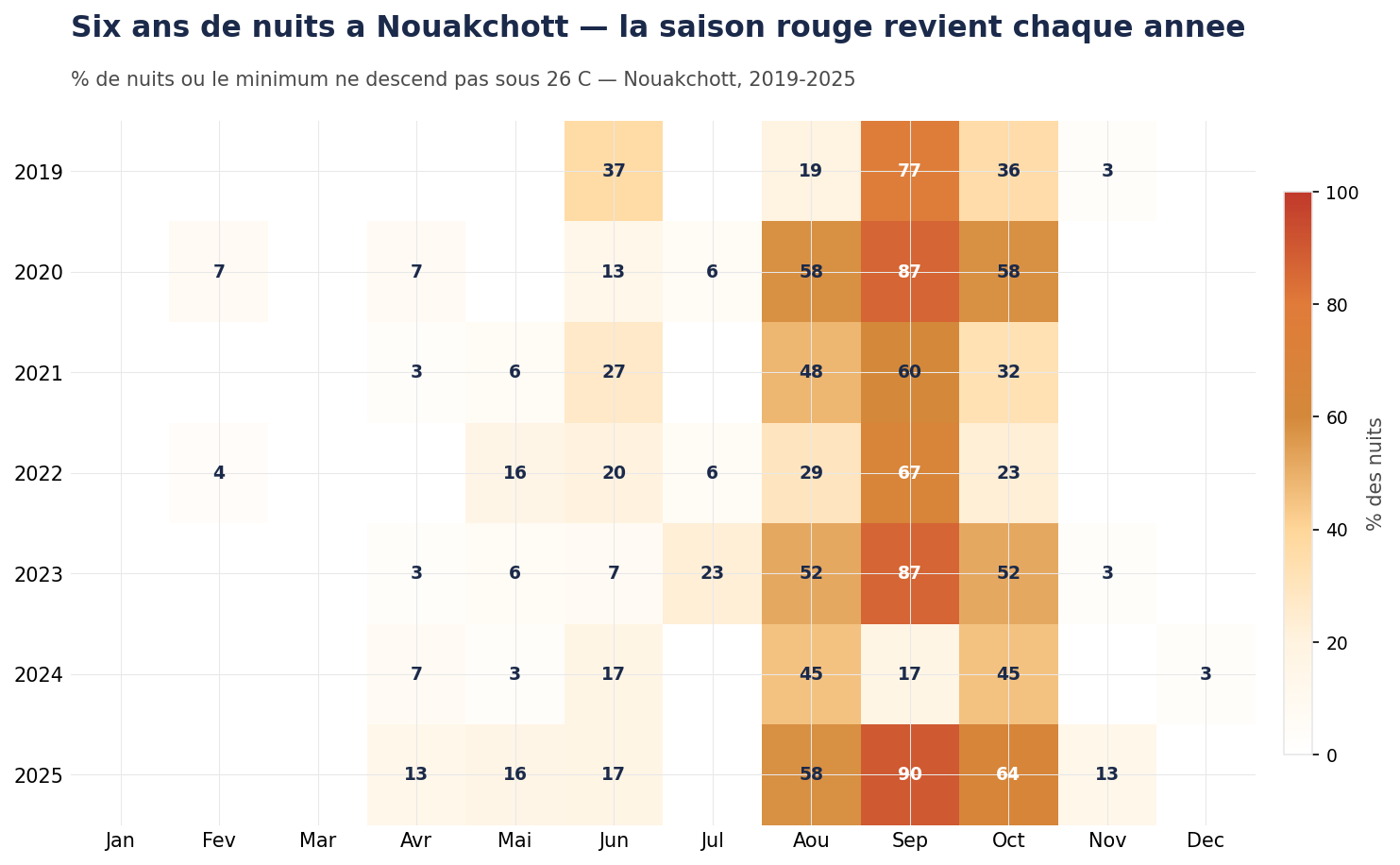
Nouakchott, 2019–2025. Threshold: nighttime minimum > 26°C.
2025: the worst year
The average over 2019–2025 is about 60 hot nights per year. Some years come in under — 42 in 2024, 50 in 2022. Others run high — 72 in 2020, 71 in 2023. But 2025 is different: 83 hot nights above 26°C, the worst year since we started measuring.
Six years of data isn't enough to claim a climate trend. We don't. What we say is that the variability is real, it's significant, and the worst years impose a pressure on the city that its infrastructure — electrical, urban, social — was not built to absorb.
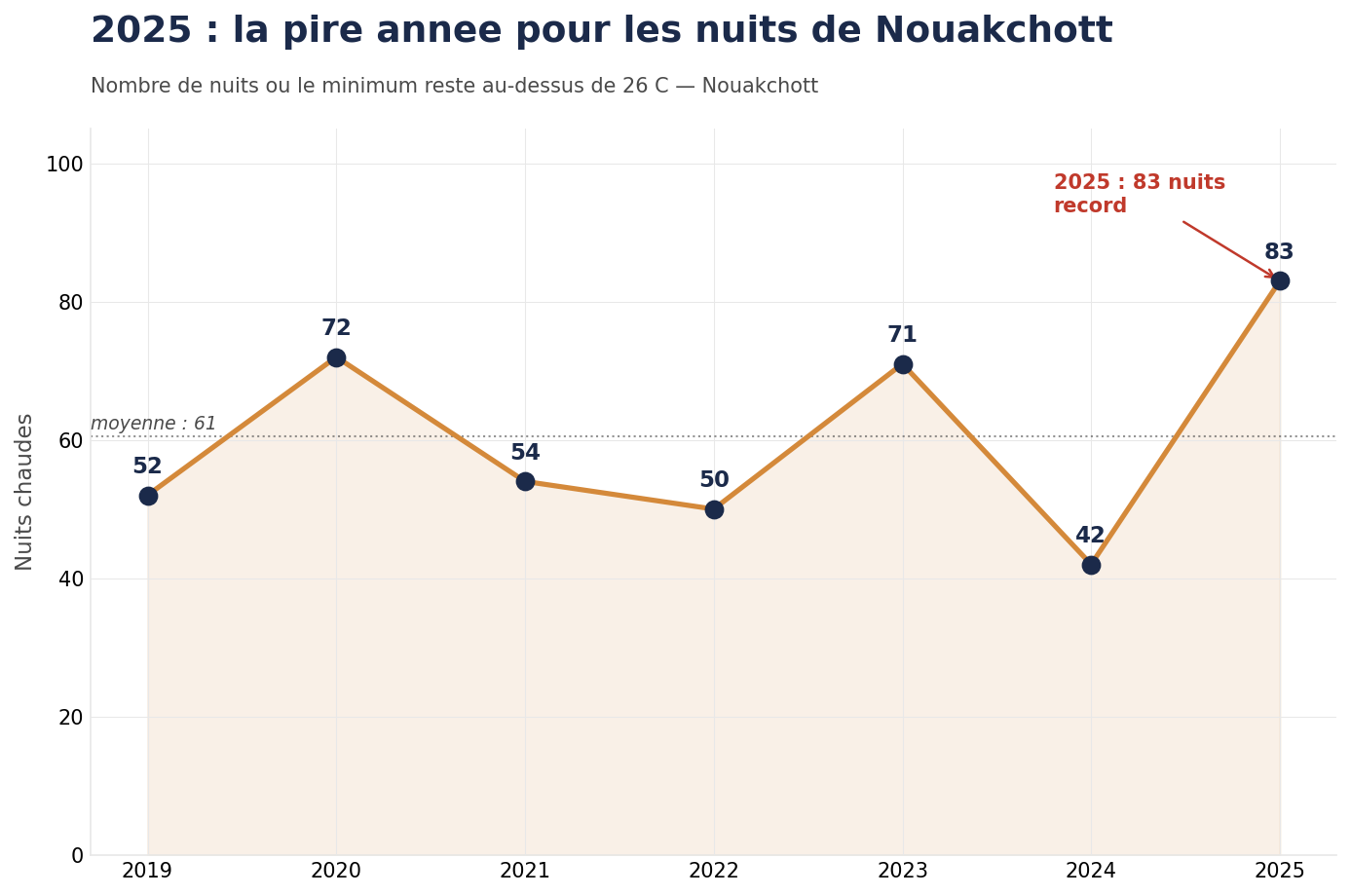
Nouakchott, 2019–2025. Threshold: nighttime minimum > 26°C.
"23 consecutive nights. Three weeks without the temperature dropping below 26°C. Three weeks without the city sleeping. That's what Nouakchott pays every September."